When verifying a clear text signature with Kleopatra notepad, only the verified part must be shown. then Kleopatra should only show the signed text in the notepad if the signature is good.
Description
Description
Revisions and Commits
Revisions and Commits
| rLIBKLEO Libkleo | |||
| rLIBKLEO06473117f5b6 Add helper to check if a signature is good | |||
| rLIBKLEO3de2e13e0e96 Add helper to check if a signature is good | |||
| rKLEOPATRA Kleopatra | |||
| rKLEOPATRAee75434aa1ef Only show clear-signed text with good signature in notepad | |||
| rKLEOPATRA91e027afaf49 Only show clear-signed text with good signature in notepad | |||
Related Objects
Related Objects
Event Timeline
Comment Actions
is a spoofed file which verifies okay but shows the inserted and not signed final line. +FWIW, gpa gets it right+.
Note that with gnupg 2.2 that file produces a BAD signature error due to internal changes in the armor parsing. You would need to spoof it a bit different with 2.2
Comment Actions
On Linux, Kleopatra (master) with GnuPG 2.5 (master) shows a BAD signature. It shows the same output as running gpg --verify --output bla.txt in Konsole and pasting the file content (by maybe the copy paste changes some control characters). If I run gpg --verify --output bla.txt <payload.spoofed.asc then bla.txt also contains the same data.
I don't understand what you mean by "only the verified part must be shown". Please clarify. Note that Kleopatra doesn't do any parsing. If gpgme identifies the content of the notepad as signed data then Kleopatra passes the content of the notepad verbatim to gpg --verify --output ....
Comment Actions
I originally uploaded a wrong copy of the file. Now fixed; the correct checksum is 8d830a2dd7e1e14ecbc47b8cdc61d393e9d3f62c
Comment Actions
I think we are all wrong here. We were tricked by the fact that regardless of the outcome of the signature verification the signed content is shown. That is surprising for a cleartext signature because that one can be viewed anyway. Thus I propose to not update the clipboard unless the signature checks out.
Comment Actions
It turns out that Kleopatra's notepad converts the CR characters of the spoofed file to LF characters when pasting the text so that Kleopatra doesn't really verify the content of the spoofed file but different content. And this results in a bad signature. The confusing bit is that Kleopatra also says "Successfully verified the notepad" and that it shows the claimed-to-be-signed text although the signature is bad which could lead an inattentive user to the assumption that the signature of the displayed text was actually good (because "Successfully verified").
Comment Actions
I have verified (by looking at QTextEdit's code) that, on paste, QTextEdit splits the text for the internal representation into lines and discards any CR and LF characters.
Comment Actions
Done. I've used the following script to create clear-signed test messages with good/bad signature signed with certificates with different validity and status (expired, revoked).
Comment Actions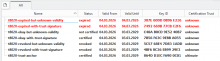
Looks good to me on gpg4win-5.0.2-beta2 @ win11 (although there might be unrelated issues, see notes in the end).
Tests of all messages generated by create-test-data.sh:
Keyring:

- bad-signature-by-t8020-expired-but-unknown-validity.asc
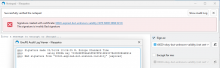
- bad-signature-by-t8020-expired-with-trust-signature.asc
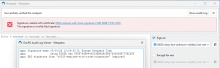
- bad-signature-by-t8020-okay-but-unknown-validity.asc
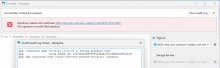
- bad-signature-by-t8020-okay-with-trust-signature.asc
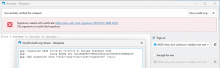
- bad-signature-by-t8020-revoked-but-unknown-validity.asc
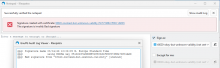
- bad-signature-by-t8020-revoked-with-trust-signature.asc
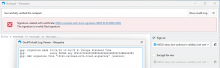
- good-signature-by-t8020-expired-but-unknown-validity.asc
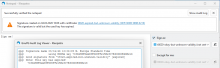
- good-signature-by-t8020-expired-with-trust-signature.asc
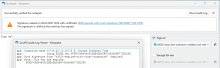
- good-signature-by-t8020-okay-but-unknown-validity.asc
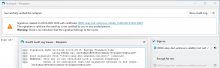
- good-signature-by-t8020-okay-with-trust-signature.asc
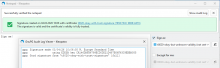
- good-signature-by-t8020-revoked-but-unknown-validity.asc
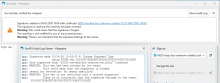
- good-signature-by-t8020-revoked-with-trust-signature.asc
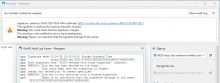


Notes:
- Bad signature with/without trust cannot be distinguished (probably ok)
- Good signature with expired cert: with/without trust cannot be distinguished (might be a good idea)
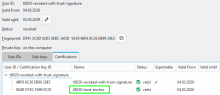
- Good signature with revoked cert: trust is displayed but wrong for the last one with trust (good-signature-by-t8020-revoked-with-trust-signature.asc)?

Comment Actions
Regarding the notes (after discussion with @ikloecker ):
- Bad signature with/without trust cannot be distinguished
This is fine. Trust is not important on bad signatures.
- Good signature with expired cert: with/without trust cannot be distinguished
Already tracked in T7790: Kleopatra: "no trusted certification" should have precedence over "expired" in signature verification.
- Good signature with revoked cert: trust is displayed but wrong for the last one with trust
Probably also related to T7790: Kleopatra: "no trusted certification" should have precedence over "expired" in signature verification.
Revoked certs shouldn't be trusted anyway (unless the revokation reason allows it, which can't be handled automatically).